Changing stories of inquiry. What are the possibilities for Appreciative Approaches?

17 March 2026 

Practitioner enquiry is central to professional learning in Scotland. As our curriculum continues to reform, exploring different approaches to enquiry can spark creative developments in practice and lead to positive outcomes for all learners. In this blog post, Dr Carolyn Cooke and Dr Claire Saunders explore the potential of working with an appreciative enquiry method alongside practitioners.

What comes to mind when you hear the term ‘inquiry’? When asking groups of practitioners this question we often hear responses such as ‘putting an issue under a microscope’, ‘a formal process’, ‘finding a solution’, ‘working through an inquiry cycle’, ‘taking a questioning stance’ or ‘investigating what is causing a problem’. None of this is incorrect – they can all be part of inquiry, but is this the only story of what inquiry can mean? Would a different story of inquiry give us scope for different ways to develop practices?

Our free course, An appreciative approach to inquiry, takes a different perspective. We have used Appreciative Approaches with well over 150 practitioners from Early Years to HE education settings in Scotland, where this alternative story of inquiry create different conversations, generates different ideas and leads to different practice developments.

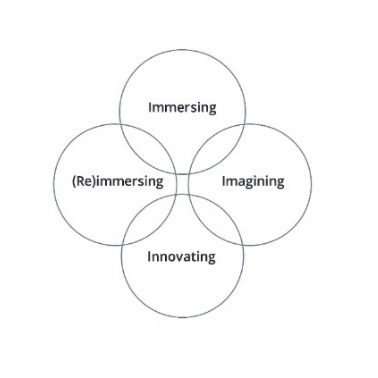
Our Appreciative cycle (figure 1) was developed from bringing together the ideas of leading Appreciative Approach authors (Bushe 2007, Cooperider et al. 2008, Gaye 2004) and our research on storytelling and professional learning (Cooke 2021, Saunders 2020).

Four interlocking circles which each have a title: Immersing, Imagining, Innovating and Re-immersing
Figure 1: The Appreciative Cycle (Cooke and Saunders 2023)

Key to this approach is that the four elements (immersing, imagining, innovating and re-immersing) are not a linear structure. It is highly likely that imagining might lead to further immersing, or that innovating might lead to further imagining of different directions to explore.

While not suggesting that all other forms of inquiry have all these features, table 1 is a useful way to show the different types of stories created by our take on Appreciative Approaches.

Features of Appreciative Approaches
Features that may be evident in other forms of Inquiry Features of Appreciative Approaches
Start from identifying a problem Start by identifying a ‘positive core’ - what is working well? What has the generative potential to be developed further?
Baseline data Immersion and deep engagement with the present. This may include data but also relies on other forms of knowing (senses, intuition, etc.)
Reliant on reflection – ‘what is’. Promotes imagining and dreaming to generate from the positive core. This focuses attention on ‘what could be’ based securely on what is already working well.
Pre-planned actions or interventions stemming from original problems or questions Improvised and generative actions that are responsive to the changing contexts of the inquiry as it develops. Questions and further avenues for exploration (through immersing and imagining) can happen at any point.
Often presented as ‘neat’ narratives (problem – actions – outcomes – solution) Appreciative Approaches promote attentiveness, responsiveness and improvisatory action, where ‘neat’ narratives are more difficult to arrive at. Instead, inquiry sits between being a process and a stance, where the generation of different practices continues to feed an inquiry stance.

So how does an appreciative approach work?

Immersing

We don’t often talk of immersing in our practices. Sometimes, with frameworks focused on reflection, we put value on ‘stepping back’, trying to have some analytical distance. While undoubtedly useful for certain aspects of practice, what happens if instead we develop our inquiry stance from ‘getting stuck in’, staying in the messiness of practice and understanding what is occurring, not from a distance, but as a ‘felt’ experience? Such immersion requires us to engage, not only with the headline issues or circumstances, but with a plethora of ‘small stories’ (Boje 2011).

So how do we immerse? In our course and the workshops, we use a variety of creative writing and storying techniques. These include techniques such as free writing, found poetry, thinking with visual metaphors and sensorial responses to practices.

Imagining

Again, imagining is a word that we don’t often talk about in education, but as Bushe argues, change can only happen at the speed of imagination, where imagining liberates our collective aspirations for the future (Bushe, 2007, p.5).

When thinking about imagining, we can easily dismiss it as something fantastical and ultimately unachievable (for example imagining that we teach classes of 5 students) but imagining as part of Appreciative Approaches is developed from the immersion phase, where it is rooted in the present, and imaginings of ‘what could be’ arise from understanding current practices.

This is easily the hardest part of working with the appreciative approach. As a result, we have developed a series of activities that can help practitioners generate ideas. Many of these techniques arise from theatre improv games, including the powerful idea of ‘What if.... Yes, and’ (Johnstone 1987), and speculative storytelling techniques. The energy of generating collaboratively is often really exciting!

Innovating

Often in inquiry the ‘doing’ phase is separated off, where it is planned from the reflection and baseline evidence of a problem, and then is seen through (as pre-planned) to its completion before reflection occurs. Of course, this is actually an impossibility in complex education settings, where reflection in action as well as on action cannot be suspended until we reach the ‘correct’ phase of the inquiry cycle, and where contextual issues and changes often mean we cannot carry out the planned action exactly as expected. The difference of the Appreciative Approach is that innovating isn’t seen as the carrying out of an entirely pre-ordained plan but encourages us to improvise. This isn’t to say we start without any plans, but it is more loosely and responsively designed. In our course and workshops, we frame this phase as having two guiding elements.

A provocative proposition about what the future practice is that we are trying to move towards (this is rooted to current practices through the immersing and imagining phase).

A gameplan which outlines the ‘conditions for change’, those things that will allow us to innovate and respond to how the innovation is working.

Re-immersing

Acknowledging that all innovations, however small, will have an impact on many related aspects of practice, not just one issue, re-immersing is an ongoing element of our Appreciative approach. This re-immersing process mirrors the initial immersing, and is characterised by curious questions, open-ended reflections and telling stories of practice – all acting as potential jumping off points for generating further alternative ways of being and doing. This changes the conversation about ‘what counts’ as evaluative evidence. While it may include data, or traditional forms of evaluation (e.g. pupil voice responses, samples of work, reflective writing) it also creates space for valuing practitioners' emotional responses, creative writing, images, and many other forms of evidence that may develop during the innovating phase.

A different story....

We invite you to try a small activity that can help you begin to explore an appreciative stance in your own enquiry.

Immerse

Firstly, take a moment to consider either an aspect of practice that you feel proud of, or excited by or a practice you feel has the potential to be developed further. Spend 2 minutes writing freely about that practice.

Imagine

Secondly, write 4 ‘What if…’ statements about your chosen practice. Try to think beyond the current practices and resist the temptation to block ideas with thoughts of ‘no, but….’.  
 
‘What if........
‘What if........
‘What if........
‘What if........

Generate further imaginings

Finally, for each of your ‘what if…’ statements, add at least two ‘yes, and’ statements.

For example,

What if we asked small groups of pupils to talk with us about their curriculum experiences?

Yes, and we could run it during lunchtime and offer them a hot chocolate

Yes, and we could have different topics for feedback each time.

References

Boje, D. (2011) ‘Introduction to agential narratives that shape the future of organisations’, in D. Boje (ed.) Storytelling and the future of organisations: An antenarrative handbook. London: Routledge.

Bushe, G.R. (2007) ‘Appreciative Inquiry is not (just) about the positive’, OD Practitioner, 39(4), pp.30-35.

Cooke, C (2021) Troubling' Music Education: (Re-)making research and music education differently, PhD thesis, University of Edinburgh. 

Cooke, C and Saunders, C (2023) An Appreciative Approach to Inquiry.

Cooperrider, D L., Stavros, J.M and Whitney, D (2008). The Appreciative Inquiry Handbook: For Leaders of Change. Berrett-Koehler Publishers.

Ghaye, T. et al. (2008) ‘Participatory and Appreciative Action and Reflection (PAAR) – Democratizing Reflective Practices’, Reflective Practice 9(4) pp.361–397.

Johnstone, K. (1987). Impro: Improvisation and the Theatre. New York: Routledge.

Saunders, C (2020) Building a community of learners in a university: An ethnographic study’ EdD thesis, The Open University.

About the authors

Photo of Dr Carolyn CookDr Carolyn Cooke, Senior Lecturer, The Open University Scotland.

Carolyn was originally a secondary music teacher before moving into teacher education. With over 20 years’ experience, she has worked across all four nations of the UK. Her current work is focused on the OU Master’s in Education programme and professional doctorate supervision.  

Photo of Dr Claire SaundersDr Claire Saunders, Senior Lecturer and Associate Dean Teaching and Students for the Faculty of Wellbeing, Education and Language Studies (WELS), The Open University.

Claire originally spent 11 years as a primary teacher. Claire has worked in Higher Education for 15 years, supporting new and practising teachers in both FE and HE. From 2020-2023 Claire was the Director of Praxis (Centre for Scholarship and Innovation in the WELS faculty) and is now Associate Dean, Students and teaching in WELS. She is active in national and international Scholarship of Teaching and Learning networks.

Changing stories of inquiry. What are the possibilities for Appreciative Approaches?

17 March 2026 

Practitioner enquiry is central to professional learning in Scotland. As our curriculum continues to reform, exploring different approaches to enquiry can spark creative developments in practice and lead to positive outcomes for all learners. In this blog post, Dr Carolyn Cooke and Dr Claire Saunders explore the potential of working with an appreciative enquiry method alongside practitioners.

What comes to mind when you hear the term ‘inquiry’? When asking groups of practitioners this question we often hear responses such as ‘putting an issue under a microscope’, ‘a formal process’, ‘finding a solution’, ‘working through an inquiry cycle’, ‘taking a questioning stance’ or ‘investigating what is causing a problem’. None of this is incorrect – they can all be part of inquiry, but is this the only story of what inquiry can mean? Would a different story of inquiry give us scope for different ways to develop practices?

Our free course, An appreciative approach to inquiry, takes a different perspective. We have used Appreciative Approaches with well over 150 practitioners from Early Years to HE education settings in Scotland, where this alternative story of inquiry create different conversations, generates different ideas and leads to different practice developments.

Our Appreciative cycle (figure 1) was developed from bringing together the ideas of leading Appreciative Approach authors (Bushe 2007, Cooperider et al. 2008, Gaye 2004) and our research on storytelling and professional learning (Cooke 2021, Saunders 2020).
Four interlocking circles which each have a title: Immersing, Imagining, Innovating and Re-immersing
Figure 1: The Appreciative Cycle (Cooke and Saunders 2023)

Key to this approach is that the four elements (immersing, imagining, innovating and re-immersing) are not a linear structure. It is highly likely that imagining might lead to further immersing, or that innovating might lead to further imagining of different directions to explore.

While not suggesting that all other forms of inquiry have all these features, table 1 is a useful way to show the different types of stories created by our take on Appreciative Approaches.

Features of Appreciative Approaches
Features that may be evident in other forms of Inquiry Features of Appreciative Approaches
Start from identifying a problem Start by identifying a ‘positive core’ - what is working well? What has the generative potential to be developed further?
Baseline data Immersion and deep engagement with the present. This may include data but also relies on other forms of knowing (senses, intuition, etc.)
Reliant on reflection – ‘what is’. Promotes imagining and dreaming to generate from the positive core. This focuses attention on ‘what could be’ based securely on what is already working well.
Pre-planned actions or interventions stemming from original problems or questions Improvised and generative actions that are responsive to the changing contexts of the inquiry as it develops. Questions and further avenues for exploration (through immersing and imagining) can happen at any point.
Often presented as ‘neat’ narratives (problem – actions – outcomes – solution) Appreciative Approaches promote attentiveness, responsiveness and improvisatory action, where ‘neat’ narratives are more difficult to arrive at. Instead, inquiry sits between being a process and a stance, where the generation of different practices continues to feed an inquiry stance.

So how does an appreciative approach work?

Immersing

We don’t often talk of immersing in our practices. Sometimes, with frameworks focused on reflection, we put value on ‘stepping back’, trying to have some analytical distance. While undoubtedly useful for certain aspects of practice, what happens if instead we develop our inquiry stance from ‘getting stuck in’, staying in the messiness of practice and understanding what is occurring, not from a distance, but as a ‘felt’ experience? Such immersion requires us to engage, not only with the headline issues or circumstances, but with a plethora of ‘small stories’ (Boje 2011).

So how do we immerse? In our course and the workshops, we use a variety of creative writing and storying techniques. These include techniques such as free writing, found poetry, thinking with visual metaphors and sensorial responses to practices.

Imagining

Again, imagining is a word that we don’t often talk about in education, but as Bushe argues, change can only happen at the speed of imagination, where imagining liberates our collective aspirations for the future (Bushe, 2007, p.5).

When thinking about imagining, we can easily dismiss it as something fantastical and ultimately unachievable (for example imagining that we teach classes of 5 students) but imagining as part of Appreciative Approaches is developed from the immersion phase, where it is rooted in the present, and imaginings of ‘what could be’ arise from understanding current practices.

This is easily the hardest part of working with the appreciative approach. As a result, we have developed a series of activities that can help practitioners generate ideas. Many of these techniques arise from theatre improv games, including the powerful idea of ‘What if.... Yes, and’ (Johnstone 1987), and speculative storytelling techniques. The energy of generating collaboratively is often really exciting!

Innovating

Often in inquiry the ‘doing’ phase is separated off, where it is planned from the reflection and baseline evidence of a problem, and then is seen through (as pre-planned) to its completion before reflection occurs. Of course, this is actually an impossibility in complex education settings, where reflection in action as well as on action cannot be suspended until we reach the ‘correct’ phase of the inquiry cycle, and where contextual issues and changes often mean we cannot carry out the planned action exactly as expected. The difference of the Appreciative Approach is that innovating isn’t seen as the carrying out of an entirely pre-ordained plan but encourages us to improvise. This isn’t to say we start without any plans, but it is more loosely and responsively designed. In our course and workshops, we frame this phase as having two guiding elements.

A provocative proposition about what the future practice is that we are trying to move towards (this is rooted to current practices through the immersing and imagining phase).

A gameplan which outlines the ‘conditions for change’, those things that will allow us to innovate and respond to how the innovation is working.

Re-immersing

Acknowledging that all innovations, however small, will have an impact on many related aspects of practice, not just one issue, re-immersing is an ongoing element of our Appreciative approach. This re-immersing process mirrors the initial immersing, and is characterised by curious questions, open-ended reflections and telling stories of practice – all acting as potential jumping off points for generating further alternative ways of being and doing. This changes the conversation about ‘what counts’ as evaluative evidence. While it may include data, or traditional forms of evaluation (e.g. pupil voice responses, samples of work, reflective writing) it also creates space for valuing practitioners' emotional responses, creative writing, images, and many other forms of evidence that may develop during the innovating phase.

A different story....

We invite you to try a small activity that can help you begin to explore an appreciative stance in your own enquiry.

Immerse

Firstly, take a moment to consider either an aspect of practice that you feel proud of, or excited by or a practice you feel has the potential to be developed further. Spend 2 minutes writing freely about that practice.

Imagine

Secondly, write 4 ‘What if…’ statements about your chosen practice. Try to think beyond the current practices and resist the temptation to block ideas with thoughts of ‘no, but….’.  
 
‘What if........
‘What if........
‘What if........
‘What if........

Generate further imaginings

Finally, for each of your ‘what if…’ statements, add at least two ‘yes, and’ statements.

For example,

What if we asked small groups of pupils to talk with us about their curriculum experiences?

Yes, and we could run it during lunchtime and offer them a hot chocolate

Yes, and we could have different topics for feedback each time.

References

Boje, D. (2011) ‘Introduction to agential narratives that shape the future of organisations’, in D. Boje (ed.) Storytelling and the future of organisations: An antenarrative handbook. London: Routledge.

Bushe, G.R. (2007) ‘Appreciative Inquiry is not (just) about the positive’, OD Practitioner, 39(4), pp.30-35.

Cooke, C (2021) Troubling' Music Education: (Re-)making research and music education differently, PhD thesis, University of Edinburgh. 

Cooke, C and Saunders, C (2023) An Appreciative Approach to Inquiry.

Cooperrider, D L., Stavros, J.M and Whitney, D (2008). The Appreciative Inquiry Handbook: For Leaders of Change. Berrett-Koehler Publishers.

Ghaye, T. et al. (2008) ‘Participatory and Appreciative Action and Reflection (PAAR) – Democratizing Reflective Practices’, Reflective Practice 9(4) pp.361–397.

Johnstone, K. (1987). Impro: Improvisation and the Theatre. New York: Routledge.

Saunders, C (2020) Building a community of learners in a university: An ethnographic study’ EdD thesis, The Open University.

About the authors

Photo of Dr Carolyn CookDr Carolyn Cooke, Senior Lecturer, The Open University Scotland.

Carolyn was originally a secondary music teacher before moving into teacher education. With over 20 years’ experience, she has worked across all four nations of the UK. Her current work is focused on the OU Master’s in Education programme and professional doctorate supervision.  

Photo of Dr Claire SaundersDr Claire Saunders, Senior Lecturer and Associate Dean Teaching and Students for the Faculty of Wellbeing, Education and Language Studies (WELS), The Open University.

Claire originally spent 11 years as a primary teacher. Claire has worked in Higher Education for 15 years, supporting new and practising teachers in both FE and HE. From 2020-2023 Claire was the Director of Praxis (Centre for Scholarship and Innovation in the WELS faculty) and is now Associate Dean, Students and teaching in WELS. She is active in national and international Scholarship of Teaching and Learning networks.