
 Share
Share
 Tweet
Tweet

Learning to read in the early years enquiry: Rattray Primary School, Perth and Kinross
The Learning to Read in the Early Years programme and the associated professional learning resource provides an in-depth, research-informed opportunity for schools and ELC settings to strengthen early reading practice. The programme supports participants to connect research with classroom and setting practice through videos, reflective activities, professional dialogue and collaborative learning. Delivered to trios of practitioners and leaders within schools or settings, the programme culminates in a small-scale enquiry project tailored to local priorities and learner needs.
Enquiry focus
Following the move to play-based learning, we noticed most children were not choosing to use or access books. We wanted to develop positive, lifelong reading habits from an early age.
Baseline data told us only 24% of children were choosing to engage in reading based activities in child initiated play.
Rattray Primary School, located in Blairgowrie, has a school roll of 230 pupils, and a further 72 children within a 50-week Early Learning and Childcare (ELC) setting. The ELC includes 10 allocated Strong Start places, all of which have a consistent waiting list.
Although classed as rural, the school serves a community with predominantly social housing and differs significantly from other local schools. Just under 70% of pupils live in SIMD data zones 1–5, with over 40% in quintile 1. Around 40% of pupils receive additional support for learning, and 10% have English as an Additional Language (EAL).
Staff involved were:
- Sarah Russell (P2 Class Teacher)
- Dee Wigmore (Nursery Teacher)
- Danielle McAlpine (P1 teacher)
- Karen McCulloch ( P1 teacher)
By February 2025, 50% of children in P1 and P2 will choose to engage with texts in their child initiated play (Baseline 24%).
We planned to measure impact using the Leuven Scale, observations, and discussions with children about their attitudes towards reading and the books they have read.
We hoped to see increased engagement in book-related activities.
We made a number of small changes to practice. These included
- building more time for shared reading into the day by using class book votes, Read, Write, Count bags, and making sure an adult was available in the reading area at scheduled times
- creating cosy, inviting reading spaces and involving children in choosing which books to read and add to the classroom
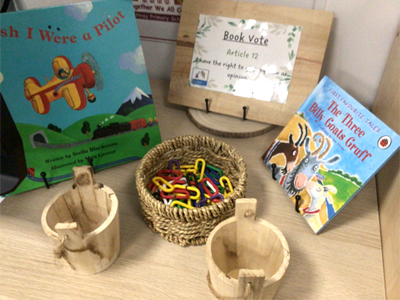
We noticed the class book vote got the children talking about books, discussing their choices, and coming back to read stories again, indicating a shift in confidence.
More children, especially hesitant readers, started visiting the cosy reading area when an adult was available to read with them.
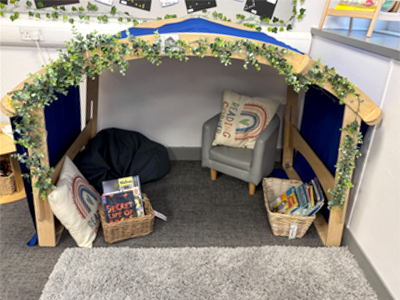
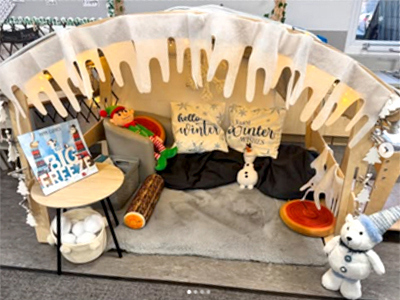
Taking part in the programme helped the infant team notice what gets children excited about reading as well as possible barriers.
Visits to the cosy reading corner increased, and observations showed children were interacting and revisiting books read together, showing growing ownership and enjoyment.
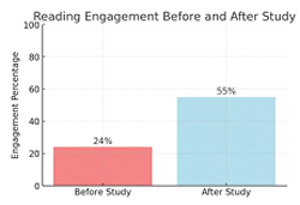
Reading engagement, measured by how many children actively chose to engage with books during play or reading activities, rose from 24% to 55%, and two-minute Leuven Scale observations showed increased focus for all three targeted children.
Children are excited about reading when they can choose books that interest them and feel ownership over their reading.
Some challenges include children quickly switching books, classroom distractions, and limited adult time to support reading.
A positive unintended outcome was that our focus on reading for pleasure also sparked greater interest in writing, so we added resources to help children create their own books.
How has the learning from the initial programme been taken further by you or your colleagues in your ongoing practice? How have you shared the learning with others?
We have continued to build on the approaches introduced during the programme. Shared reading and book voting are now embedded in our daily routines, and all early level staff involve children more actively in choosing and discussing texts. Our redesigned cosy reading areas have been maintained and regularly updated, which has helped sustain children’s interest in books.
We now plan for intentional adult interaction in the reading space, recognising the impact this had on children’s confidence and engagement. The learning has also been shared with colleagues beyond P1–P2, leading to similar approaches being trialled elsewhere in the school.
We also shared key findings informally at staff meetings, which prompted useful discussion about reading engagement across the school. Our approach and outcomes have supported other staff to reflect on their own reading environments and routines, helping spread the impact beyond the original P1-2 focus.
Share this resource: