
Young anti-racist voices of Scotland: Anti-racism in Scottish schools
The voices of young people remain central to shaping anti-racist education. The case studies below provide examples from the Young Anti-Racist Voices of Scotland Anthology and HM Inspectors of Education (HMIE) findings.
Case studies highlight how schools and settings across Scotland are embedding anti-racist approaches in meaningful and sustained ways. They illustrate what effective practice can look like and the impact it can have on learners, staff, and communities.
Anti-racism and racial literacy at Newark Primary School highlights how a whole school approach is supporting the development of racial literacy, embedding anti-racist values across learning, teaching and school culture.
Empowering pupil voice through anti-racist storytelling and digital animation at Inverkip Primary and Nursery showcases how learners are empowered to explore and express anti-racist perspectives through creative storytelling and digital animation, strengthening pupil voice and inclusion.
Gourock against Racism was created by P7 pupils at Gourock Primary School as part of cluster initiative with the Gourock Schools and Churches to prevent racism.
They also were part of a project designing an amazing anti-racism stained glass window that’s on display at the local railway station.
Shawlands Academy pupils in S5 and S6 collaborated in a project with Newcastle University. Pupils worked collaboratively to develop 10 strategies to make your school more anti-racist.
Start an anti-racism club or association
Set up an Anti-Racism Association and work with senior students, teachers, and youth workers to provide workshops, make creative displays around school, and write an anti-racist school policy.
Find people with power at the school
Talk to trusted teachers and senior students, see what people have done already, and who make decisions about anti-racist policy and curriculum.
Source anti-racist materials: find existing materials about understanding and confronting racism, make your own, and look at how to bring these into your classes and curriculum.
Think about structural issues too and how racism overlaps with other issues: bullying and racist language are important to counter but also think about the way peoples experience of racism overlaps with other forms of discrimination such as gender, region, class, disability, and mental health.
Have conversations that challenge everyday racism: start by sharing experiences of racism together and learning about how ways to counter it and share ways to challenge racism when it happens, research together and support each other.
Start a culture day
hosting a culture day can be a fun event where people come and share music, food, dance and stories from their culture. Think about coinciding this with events such as Black History Month, South Asian Heritage Month and Gypsy, Roma and Traveller History Month.
Pupils from S1 to S3 at Dumfries High School have been making posters and artwork about the importance of speaking out about racism.
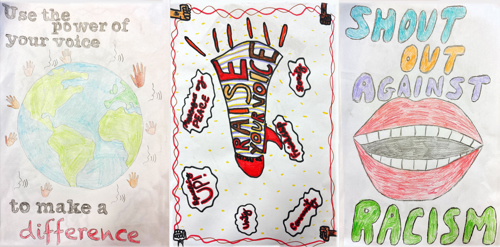
Artwork is part of a broad project looking at Anti-racism and how to make anti-racists of everyone. They also shed light on Black History Month.
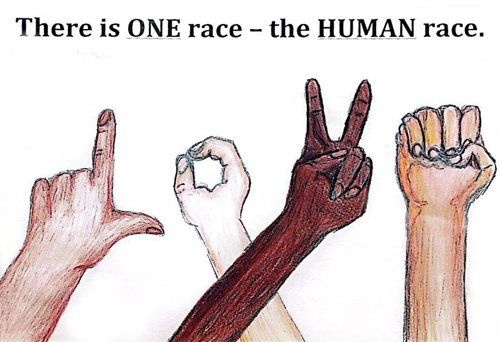
Pupils in the Anderson Primary Anti-racism Club spent time practising their digital art skills, creating a series of posters and poems to express and share anti-racist messages.
Their work highlights the importance of inclusion, respect, and standing up for others.
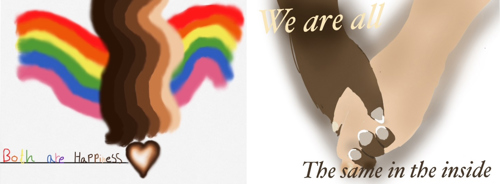
Pupils from the Firrhill Rights Respecting Schools Equalities group were invited to take part in a project supporting the planning of the school’s first Multicultural Family event. They have been involved in several ongoing school initiatives exploring young people’s rights in relation to heritage, culture, and identity. This has included collaborating with a local artist on banner designs to welcome visitors to the school, contributing to a photography project about what Edinburgh means to them, and creating poetry inspired by their backgrounds.
Independently, some pupils decided to write poetry reflecting on their personal journeys. These focus on themes such as belonging, identity, home, and their experiences of racism, prejudice, and inequality. This was a deeply personal project for each of them, and they chose to highlight aspects of identity that hold particular meaning. Some of their work has been spotlighted through poetry pages of this anthology.
Pupils in P7 at Clovenstone Primary created posters as part of Black History Month.
"As a class we realised that Black History should not be confined to a 30-day period but should be included in every aspect of learning."
Pupils in S2 at St Augustine's High have been writing and creating artwork for children’s stories about fighting prejudice and discrimination. They are hoping to work with local libraries and other schools to share their stories over the next year.
At Newark Primary School in Port Glasgow, a group of children wanted to speak up about racism. They were part of an anti-racism club and had big ideas.
They wanted a billboard to share their message with the whole town. They made posters and put them up in shops, health centres, and other places.
But they still dreamed bigger. They created We Are All Special (YouTube). In this short film they use their own stories, pictures, and voices. It had a film premiere at the cinema where people came to watch it on the big screen. They also got their billboard.
Find more information on the Newark Primary anti-racism club story (bellacaladonia.org).
Read the Newark Primary School inspection case study (HMIE).
Pupils in primary and secondary schools across South Ayrshire worked collaboratively on creating a film about anti-racism. This aired at their anti-racism film festival in 2025 and then again at their equalities conference in 2026.
They ran their own awards night to recognise those who were part of the project and pupils spoke about why they wanted to be part of the project.
You can see some of their quotes below:
“I am part of the anti-racism group because we need to stand up for others”.
“I don’t want anyone to feel isolated or struggle at school, I want to make a change, we should all feel included”.
“I had lots of fun working on the film, but I learned how mean people can be and I want it to stop”.
“It makes me sad when I hear people being racist, I want to teach them to be kind”.
Pupils from Inverkip Primary are working with The Watt Institution to produce an animated film exploring Inverclyde’s colonial legacies through the museum’s collection. The project examines how artefacts were acquired, their impact on people and environments, and the connections between colonialism and climate justice.
“We’ve learned about how indigenous people used the properties of horseshoe crabs in medicine sustainably and how industrialisation brought the crabs to near extinction.
"We 3d scanned a sugar beetle found in one of the sugar sacks arriving from the West Indies. This gave us a chance to handle replicas of delicate exhibits.”
An important part of the upcoming exhibition is a film encouraging young people to engage critically with difficult histories and their modern-day consequences. Alongside animation and storytelling, pupils are developing skills in research, digital media, and critical thinking.
“We had to research various habitats so that our backdrops were accurate and detailed. We used books as well as the internet to find out the information we needed.
"We found some historical images quite astounding. Here are thousands of horseshoe crabs being caught. This disregard for the balance of nature brought the crabs to ear extinction.”
A behind-the-scenes film, glossary, and museum activity trail will accompany the project, offering an engaging educational resource for schools and visitors alike.
The exhibition will be viewable in 2026.
Pupils at Drumchapel High in Glasgow have been part of an Anti-racist Club. From workshops and poetry readings to policy conversations, these young leaders are driving real, lasting change.
Their third Anti-Racism Carnival was a celebration of creativity, culture, and courage. Pupils also took part in an inspiring workshop with artist Etienne Kubwabo, exploring how storytelling can be a force against racism.
Pupils from the Anti-Racism Society pitched the idea of leading staff training and delivered a powerful session during an in-service day. Co-created and co-led by young people, the session combined honest personal stories with school survey data to spark real reflection.
Staff left inspired, informed, and full of admiration for the students’ leadership and courage. Determined to spark change, the Anti-Racism Society wrote to the Cabinet Secretary for Education and Skills and were invited to meet her. In a powerful conversation, they shared honest experiences of racism in school.
One of the young people from the Anti-Racism Society read her poem at the Scottish Parliament for International Women's Day 2024. This young person is a former vice president of the Anti-Racism Club at Drumchapel High School. She also contributed to teaching anti-racism lessons at her local primary schools and has met with the Cabinet Secretary for Education and Skills to advocate for a more inclusive curriculum.
The pupils have most recently run a live lesson for pupils in other schools for World Refugee Day to celebrate the school's links to the inspiring Glasgow Girls. We look forward to seeing all the amazing work to come.
Iram created a hand drawn, six panel cartoon strip (PDF) about challenging racism in a school. The image and description of each panel are below:
Panel 1
A student wearing a hijab stands beside another student in a school uniform who angrily points and says, “Go back to your own country you p***!”.
Panel 2
A group of students stands together, and one calls out, “Stop! That’s racist!”.
Panel 3
The group addresses the student who made the rude comment. A speech bubble reads, “How would you feel if someone was rude to you?”.
Panel 4
The student who made the rude comment sits and replies, “I would also be sad. I'm sorry.” Another speech bubble from the group says, “Let’s make some posters to raise racism awareness!”. A table with paper and markers is shown.
Panel 5
A poster lies on a table with large text reading, “Say no to racism” with a red star at the bottom.
Panel 6
A bulletin board titled “Class values” displays several papers: “treat every person with respect,” “everyone is welcome,” “say no to racism,” “show love to peers,” and “be kind to everyone.”
The Children’s Parliament anti-racist education resource captures the powerful voices and creativity of children from Dens Road Primary in Dundee. This work was developed through the Anti-Racist Education residency in partnership with Intercultural Youth Scotland. It features activities and reflections that centre children’s rights, identity, and dignity.
Children were involved at every stage, contributing their ideas, artwork, and reflections through facilitated sessions focused on identity, fairness, and racism. Their voices shaped both the content and language of the resource, resulting in practical and meaningful tools for educators.
The materials highlight how anti-racist education can be approached in age appropriate ways that centre children’s rights, experiences, and understanding.
Images created as part of a co-research project into racist peer victimisation share the experiences of young people. The photographs reflect family, the outdoors, nature, community, friendship in coping with racism.
The co-researcher’s also created a leaflet titled What we want you to know about racism. These are the photographer’s reflections on their experiences:
“It could start off as really small, like ‘look at you wearing your hijab’ or ‘why are you wearing that? That's like terrorism, you know’… then later on it becomes something bigger. So you shouldn't really bottle that up inside, because later on you're gonna get angry, those little comments that you think were really little, they’re gonna become big.”
“I didn't really tell my parents ‘cause…don't know why, I thought it was embarrassing. Now, I feel like I should have went to my parents sooner because when I was talking to my parents, they told me how they experienced racism themselves. When they came to Scotland they said that people would say ‘go back to your country’, they would throw eggs at them… if you feel like you need to tell somebody, tell somebody.”
“It's not just me who's been through this experience, everyone's got their own story, their own experience and this just shows that we should make sure to put tackling racism first before anything else as your mental health can be affected after those kind of incidents.”
“My siblings… they're probably a big help to me because they've been through it themselves. They said don't let somebody do that to you. You know they’re always like, tell somebody, you shouldn't let anyone get away with it because you're this colour, you shouldn't let anyone get away with it period.”
“That's what I think is you should always be kind … ‘cause you don't know anything that anyone's going through, do you? Because, you could look at me and you wouldn't know at all that anything happened, but it did.”
“I think similar situations have happened to each individual in the family. Or something towards that. And I think it's an understanding that it’s OK. You know, you can deal with it. It just takes time…definitely surround yourself with good people I reckon, So you always have someone to go to….my cousins, we've always just been close. I feel like they have an understanding of it because they go through it a lot in their school as well.”
