

Digging deeper into practitioner enquiry: Towards an appreciative approach to inquiry
The Open University’s approach to Appreciative Inquiry draws on workshops with over 200 education practitioners in Scotland and beyond. It is informed by their free OpenLearn course, An Appreciative Approach to Inquiry, and introduced in the Education Scotland blog post Changing Stories of Inquiry.
This introduction to Appreciative Inquiry has been authored by Dr Carolyn Cooke and Dr Claire Saunders from The Open University in Scotland, and offers an accessible starting point for practitioners interested in using strengths-based, collaborative approaches within their practice.
Central to this appreciative approach to inquiry is the use of creative writing to support playful, exploratory thinking.
Begin by reflecting on feeling appreciative
Take some time to reflect and make notes in response to the following questions:
- When was the last time you had a conversation with a colleague or peer about something exciting, interesting or energising that happened in your practice? What prompted the discussion?
- When was the last time you felt proud of the difference you had made and shared this with a colleague?
These questions are designed to help you notice and value aspects of practice that can often be overlooked. Traditional forms of inquiry can focus on identifying problems or areas for improvement. An appreciative approach does not ignore challenges; rather, it encourages us to recognise the generative potential in what is working well - what motivates us, what feels meaningful, and what could be developed further.
What is an Appreciative Approach to Inquiry?
Our Appreciative cycle (figure 1) brings together key ideas from leading authors in appreciative inquiry (Bushe, 2007; Cooperrider et al., 2008; Gaye, 2004) alongside our research on storytelling and professional learning (Cooke, 2021; Saunders, 2020).
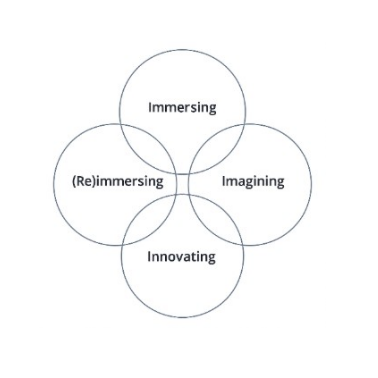
The four elements of the cycle — immersing, imagining, innovating and re-immersing — are not linear. You may move back and forth between them. For example, imagining may prompt further immersing in practice, or innovating may open up new directions for imagining.
This page focuses on immersing and imagining, supporting you to identify an appreciative focus for your own inquiry.
Starting with immersing
Immersing in practice provides a strong foundation for appreciative inquiry. It helps to root your thinking in real experiences, increasing the likelihood that any developments will be meaningful, realistic and sustainable.
Stories and poetry can be powerful tools for this process. They encourage the use of language, metaphor and imagery to explore practice in new ways and to challenge existing assumptions.
Activity 1: Immersing through free writing
Using your reflections, or another experience from your practice, spend four minutes free writing.
If you are new to free writing, follow these guidelines:
-
Set a timer for four minutes
-
Write continuously about whatever comes to mind
-
Use full sentences, but do not worry about spelling or grammar
-
Do not stop writing!
-
If you don’t know what to write, repeat “I don’t know what to write” until new ideas emerge
Activity 2: Immersing through found poetry
Re-read your writing and highlight words or phrases that really stand out to you. Arrange these words and phrases into a short poem. It does not need to rhyme.
An example poem from one of the workshops:
They swarmed
Excited
More than an explanation
Energised to think
Through these activities, you begin to notice what matters in your practice. You may find it helpful to return to this type of immersive activity regularly to support ongoing reflection and development.
Imagining and generating different possibilities
As you developed your writing and poetry, you may well have noticed particular ideas or features of an experience that have the potential to develop further.
It could be something quite small, it doesn’t have to be a grand idea, as long as it feels like it has potential beyond your initial experience of it.
Drawing on techniques from Improv theatre, we are now going to play ‘What if….’, ‘Yes, and….’ (Johnstone 1987) to help us imagine how we could develop these experiences further.
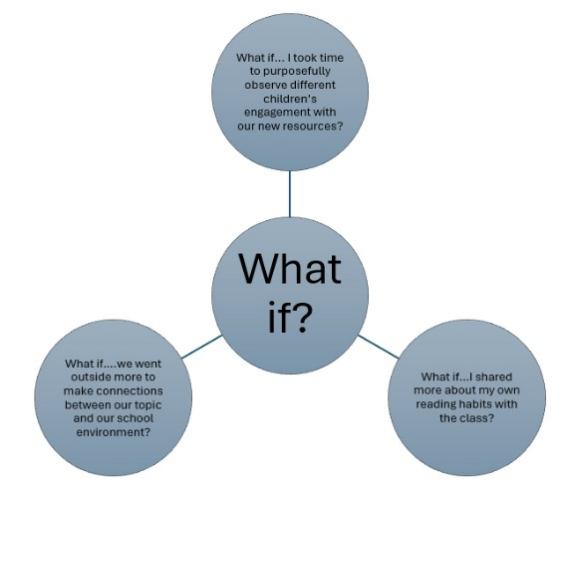
Activity 3: Imagining through ‘What if…?’
Using your writing and poem, create a mind map like the one below, where each branch responds to the question ‘What if…?’.
This stage may feel challenging, as it involves thinking beyond current practice
You may find it helpful going for a walk or doing a different activity while reflecting.
Aim to keep your ideas grounded in your context. For example:
-
Less helpful: What if we only had five learners in a class?
-
More useful: What if we created more opportunities to work with small groups?
Activity 4: Generating through ‘Yes, and…’
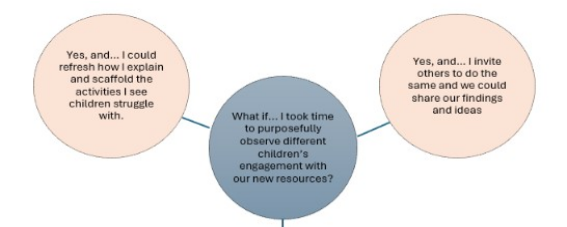
To build on your ideas, use the phrase ‘Yes, and…’. ‘This approach acknowledges what is already stated and then instead of letting ourselves block it (yes, but!), we generate further thinking.
For each of your ‘What ifs…’ add at least two ‘Yes, ands…’responses to develop your ideas further.
Working through these activities, alongside the blog and the free OpenLearn course, will help you identify aspects of your practice with potential for further inquiry. It should also support you to develop initial ideas about what you might explore next.
The ‘Innovating’ section of the course provides further guidance on experimenting and developing these ideas in practice.
What will you do next?
Appreciative approaches can be used individually or collaboratively. These activities can also be adapted for use in group or workshop settings to support shared reflection and collective development.
If you would like to explore this approach further, you can access the free OpenLearn course.
We also welcome examples of how Appreciative Inquiry is being used in practice - please get in touch to share your experience.
References
Bushe, G.R. (2007) ‘Appreciative Inquiry is not (just) about the positive’, OD Practitioner, 39(4), pp.30-35.
Cooke, C (2021) Troubling' Music Education: (Re-)making research and music education differently, PhD thesis, University of Edinburgh.
Cooke, C and Saunders, C (2023) An Appreciative Approach to Inquiry. OpenLearn (accessed 2.6.26)
Cooperrider, D L., Stavros, J.M and Whitney, D (2008). The Appreciative Inquiry Handbook: For Leaders of Change. Berrett-Koehler Publishers.
Ghaye, T. et al. (2008) ‘Participatory and Appreciative Action and Reflection (PAAR) – Democratizing Reflective Practices’, Reflective Practice 9(4) pp.361–397.
Johnstone, K. (1987). Impro: Improvisation and the Theatre. New York: Routledge.
Saunders, C (2020) Building a community of learners in a university: An ethnographic study, EdD thesis, The Open University.
